
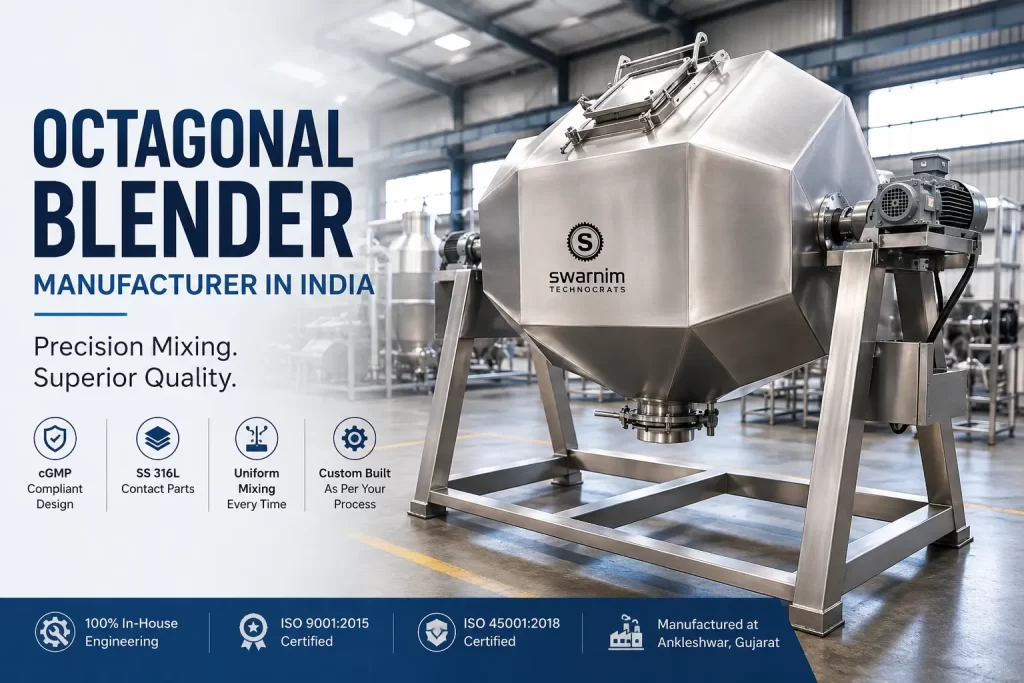
At Swarnim Technocrats, we design and manufacture octagonal blenders for pharmaceutical, chemical, nutraceutical, food, cosmetic, and other powder-processing applications.
Our equipment is engineered at our GIDC Ankleshwar, Gujarat facility, with a focus on controlled powder movement, uniform blending, hygienic construction, and reliable mechanical operation.
As an Octagonal Blender Manufacturer in India, we combine 100% in-house engineering, application-specific fabrication, and process-oriented equipment design.
Our manufacturing systems operate under ISO 9001:2015 and ISO 45001:2018 certified quality and safety frameworks.
The octagonal geometry creates repeated lifting, cascading, and redistribution of material. This promotes homogeneous blending while maintaining a gentle mixing environment.
The result is consistent blending of dry powders, granules, pharmaceutical formulations, excipients, and industrial materials with reduced product degradation.
For a general understanding of blending principles used in pharmaceutical powder processing, refer to this resource: Pharmaceutical Blending and Mixing Principles.
We size every blender according to the required batch volume and material characteristics.
The following table provides an indicative standard engineering range for preliminary selection.
Final motor power, RPM, dimensions, valve size, and structural configuration depend on product density, batch weight, material characteristics, and equipment layout.
| Technical Parameter | 100 L | 500 L | 1000 L | 2000 L | 3000 L | 5000 L |
|---|---|---|---|---|---|---|
| Gross Volume | 100 L | 500 L | 1000 L | 2000 L | 3000 L | 5000 L |
| Working Volume @ 70% | 70 L | 350 L | 700 L | 1400 L | 2100 L | 3500 L |
| Drive Motor | 1 HP / 0.75 kW | 3 HP / 2.2 kW | 5 HP / 3.7 kW | 7.5 HP / 5.5 kW | 10 HP / 7.5 kW | 15 HP / 11 kW |
| Rotation Speed | 8–18 RPM | 7–16 RPM | 6–15 RPM | 5–13 RPM | 4–12 RPM | 4–10 RPM |
| Butterfly Valve | 100 mm | 150 mm | 200 mm | 250 mm | 300 mm | 350 mm |
| Overall Dimensions L × W × H | 1500 × 900 × 1450 mm | 2200 × 1300 × 1750 mm | 2700 × 1550 × 2050 mm | 3500 × 1900 × 2450 mm | 4100 × 2200 × 2750 mm | 5000 × 2600 × 3200 mm |
| Minimum Room Height | 2400 mm | 2800 mm | 3100 mm | 3600 mm | 4000 mm | 4500 mm |
We generally consider the working volume separately from gross vessel capacity.
For preliminary sizing:
Working Volume = Gross Volume × 70%
For example, our 2,000 L reference configuration provides approximately 1,400 L working volume at a 70% fill level.
Actual working volume should be established after reviewing:
We do not select motor power from volume alone.
The final drive calculation considers batch mass, bulk density, torque requirement, rotational speed, starting load, gearbox ratio, and operating cycle.
This ensures the drive system is appropriately sized for the actual process.
As a trusted Octagonal Blender Manufacturer in India, we engineer the motor and drive system based on real process conditions rather than nominal capacity.
Our octagonal blender uses a multi-faceted rotating chamber.
The geometry continuously changes the material bed profile during rotation.
As the vessel rotates, the material moves upward along the internal surface.
Gravity then causes the material to cascade downward.
As a leading Octagonal Blender Manufacturer in India, we design this gentle tumbling action to achieve uniform blending without damaging sensitive powders and granules.
This action repeatedly separates and recombines the powder bed.
The resulting movement promotes effective radial and axial material redistribution.
Unlike high-speed mechanical mixing, the process does not depend on aggressive agitator action.
This makes the system suitable for applications requiring controlled mixing with limited mechanical stress.
A cylindrical vessel can allow material to move along a relatively stable sliding path.
Our octagonal configuration introduces multiple changes in the material trajectory.
During each rotation, the product experiences:
This helps prevent material from simply sliding along the vessel wall.
The result is more effective top-to-bottom and side-to-side blending.
We can incorporate strategically positioned completely removable internal baffles.
The baffles interrupt uncontrolled material sliding.
They lift and redirect the material during vessel rotation.
This creates additional movement through the entire product bed.
The removable design also supports easier:
Baffle configuration can be engineered according to the product and required mixing characteristics.
A large blender contains substantial rotating mass.
We therefore pay close attention to the balance of the rotating assembly.
Our equipment can be engineered with static and dynamic balancing appropriate to the machine configuration.
Correct balancing helps reduce:
A loaded blender should not receive sudden torque during startup.
We can integrate VFD-based acceleration control to gradually bring the blender to its operating speed.
This controlled acceleration reduces sudden mechanical loading.
It protects critical drive components such as:
For larger-capacity machines, controlled startup becomes especially important.
We select the MOC according to product chemistry, cleaning requirements, process conditions, and regulatory requirements.
For pharmaceutical and hygienic applications, we can provide:
Surface-finish requirements are finalized according to the customer’s URS and approved engineering drawings.
Typical non-contact construction includes:
We can modify the MOC based on corrosive or chemically aggressive products.
Our pharmaceutical equipment can be engineered around cGMP principles and hygienic process requirements.
The design focuses on:
Cleanability + Surface Finish + Drainability + Material Compatibility + Cross-Contamination Control
For pharmaceutical applications, we can incorporate:
These design principles support equipment requirements under pharmaceutical GMP frameworks, including applicable CDSCO Schedule M requirements.
For US-regulated manufacturing environments, we can engineer equipment around the customer’s applicable USFDA/GMP requirements.
Regulatory compliance, however, depends on the complete validated process.
Equipment construction alone does not establish regulatory compliance.
We can integrate our pharmaceutical mixing equipment with suitable powder charging and material-handling systems.
This allows the blender to become part of a complete material-processing line.
Our vacuum charging configuration enables closed-loop powder transfer.
The material transfers from the source container through a controlled conveying system.
This reduces manual powder handling and airborne dust.
The configuration is particularly useful for:
The system can be configured with suitable filters, receivers, valves, and transfer controls.
Our hydraulic bin charging system provides mechanical loading from IBC or process bins.
The lifting mechanism raises the container to the required discharge position.
The material then enters the blender through a controlled charging interface.
This reduces manual handling and improves batch charging consistency.
We can engineer the lifting arrangement around the available room height and blender configuration.
We can integrate PLC-based control panels for automated blender operation.
The PLC can control:
An industrial HMI touchscreen provides operators with a centralized process interface.
The interface can display:
This simplifies operation and improves process visibility.
A Variable Frequency Drive (VFD) provides controlled blender speed.
Different materials can require different operating conditions.
VFD control allows process engineers to adjust:
Controlled acceleration also reduces startup stress on the drive assembly.
For regulated pharmaceutical applications, we can develop automation architecture around electronic-record requirements.
Depending on the selected automation package, features can include:
A 21 CFR Part 11 claim should be applied only to the complete configured and validated system.
The final automation architecture is therefore defined according to the customer’s URS and validation requirements.
We do not recommend selecting an octagonal blender only by litre capacity.
The correct equipment depends on your material properties and batch requirements.
Our engineering team evaluates parameters such as:
This information allows us to engineer the blender around your actual production process.
At Swarnim Technocrats, we combine process understanding with in-house equipment engineering.
We manufacture process equipment for pharmaceutical, nutraceutical, chemical, cosmetic, food, and industrial applications.
Our capabilities extend beyond blending.
We also engineer equipment and systems for:
This enables us to engineer an octagonal blender as part of a larger pharmaceutical material-handling system, rather than treating it as an isolated machine.
Your blender should be selected around your product, batch size, density, and production layout.
Send us your:
Our engineering team can evaluate these parameters and develop the appropriate machine configuration.
We can then establish the required:
Working Volume → Batch Capacity → Drive Torque → Motor Power → RPM → Valve Size → Charging System → Dimensions → Automation
Send your material density profile, batch-size requirements, or factory layout blueprint to our Ankleshwar facility.
We will evaluate your process requirements and prepare an application-specific engineering proposal, drawing, and quotation.
Swarnim Technocrats
Plot No. 5110, GIDC Estate, Ankleshwar,
Gujarat, India – 393002
Build your next blending process around the right engineering parameters. Contact Swarnim Technocrats for your octagonal blender requirement.
Lead time depends on capacity and customisation level. Standard models in the 50–500 litre range are typically dispatched within 4–6 weeks from order confirmation. Larger or customised units may require 8–12 weeks. Confirmed timelines are provided at the time of order.
All product-contact surfaces are fabricated in SS 316 or SS 316L stainless steel. Non-contact structural components use SS 304. Material test certificates (MTCs) are provided with every machine.
Yes. All Swarnim octagonal blenders are designed and manufactured in compliance with cGMP guidelines under Schedule M. Features including mirror-polished internals, inflatable seals, safety interlocks, and complete documentation support pharma GMP environments.
Yes. Vacuum charging ports can be integrated for closed-loop powder transfer, reducing operator exposure and cross-contamination risk. This is particularly useful in high-potency API manufacturing.
Yes, load cell-based in-process weighing is available as an option for accurate batch weight monitoring without removing material from the blender.
Our blenders operate between 6 and 20 RPM via a VFD-controlled drive. Speed can be adjusted from the control panel before or during blending cycles, depending on the model configuration.
Yes. Swarnim Technocrats provides on-site installation, commissioning, and operator training. We also supply IQ/OQ documentation support for pharmaceutical clients requiring validation assistance.
Manufacturers & Exporters of Industrial Process Machineries
Copyright © Swarnim Technocrats | Designed by Z Web Solutions