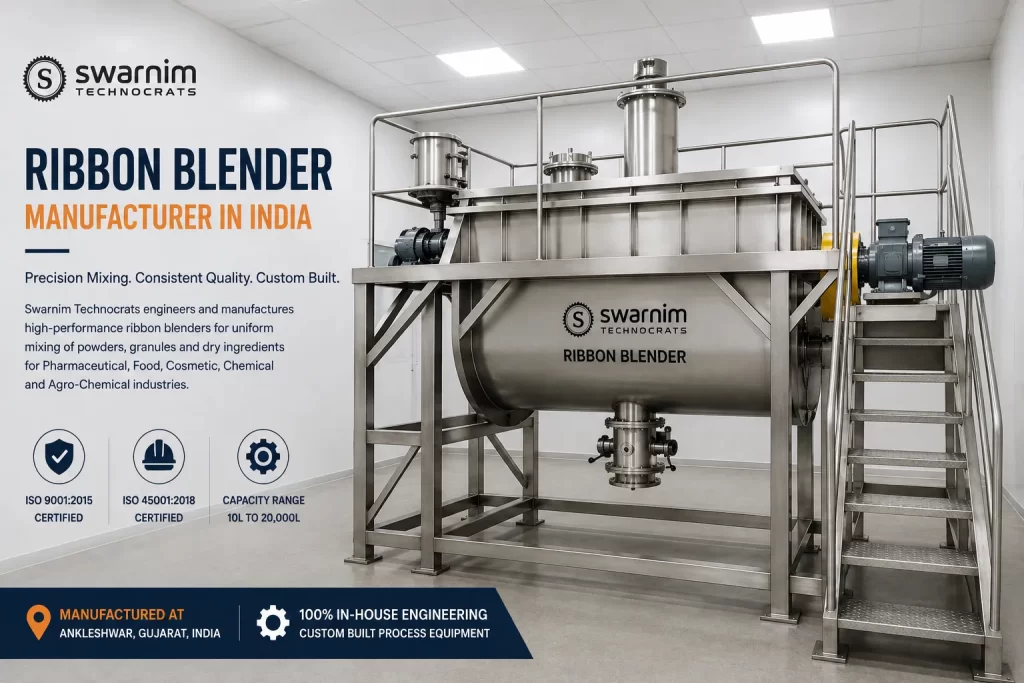
At Swarnim Technocrats, we design and manufacture industrial ribbon blenders in India for controlled mixing of powders, granules, dry ingredients, and formulations.
Established in 2000, we engineer custom-built process equipment from our manufacturing base in Ankleshwar, Gujarat.
As a trusted Ribbon Blender Manufacturer in India, we focus on delivering application-specific solutions that meet the exact process requirements of pharmaceutical, food, chemical, and industrial clients.
To understand the core mechanism of these machines, you can refer to this external resource on the Principle, Construction & Working of Ribbon Blender.
Our ribbon blenders are designed for applications across:
We engineer capacities from approximately 10 litres for R&D applications to 20,000 litres for large-scale industrial processing.
Our design approach considers more than vessel capacity. We evaluate bulk density, batch weight, powder flowability, mixing time, product sensitivity, material compatibility, discharge requirements, and installation constraints before finalizing the equipment.
Our ribbon blender uses a horizontal U-shaped trough with a double helical ribbon agitator.
The ribbon assembly consists of inner and outer helical flights. These flights move material in opposing directions during rotation.
This creates a combination of axial and radial mixing action.
Material moves longitudinally through the trough while simultaneously undergoing lateral redistribution.
The resulting counter-current radial and lateral motion repeatedly divides and recombines the material bed.
This mechanism supports low-shear homogeneous blending for many powder and granule applications.
During operation:
This design is suitable for products requiring controlled mixing rather than high-intensity mechanical shear.
We select the Material of Construction (MOC) according to the product chemistry, hygiene requirements, cleaning method, and process environment.
We can manufacture product-contact components using:
For pharmaceutical applications, SS 316L is commonly selected where enhanced corrosion resistance and sanitary construction are required.
For food and spice applications, we can configure the blender with appropriate stainless-steel product-contact surfaces and hygienic construction.
The final surface finish and MOC should be defined within the customer’s URS.
For suitable non-corrosive chemical products, we can use high-tensile Mild Steel for structural and product-contact construction where process conditions permit.
For corrosive materials, we evaluate the chemical compatibility before recommending the MOC.
A ribbon blender’s gross capacity is not the same as its usable batch capacity.
Gross Capacity represents the total internal volume of the mixing chamber.
Working Capacity represents the practical operating volume available for effective material movement.
The actual working load depends heavily on bulk density and powder characteristics.
Suppose a formulation requires a 1,000 kg batch.
A procurement team cannot select a blender simply by choosing a 1,000 L vessel.
If the product bulk density is:
0.50 kg/L
then:
Required product volume = 1,000 ÷ 0.50 = 2,000 L
The blender also requires sufficient free volume for proper ribbon movement.
Therefore, the final gross capacity must be higher than the calculated material volume.
Before finalizing the blender, we evaluate:
This prevents motor overloading, inadequate powder circulation, and poor mixing performance.
Our standard equipment range, as a leading Ribbon Blender Manufacturer in India, covers laboratory, pilot, production, and large industrial applications.
The following matrix represents the standard reference range. Final working capacity and drive selection are confirmed against product density and batch weight.
| Model | Gross Capacity | Working Capacity | Indicative Working Batch | Drive Configuration |
|---|---|---|---|---|
| ST/RB/15 | 15 L | 5 L | 5 Kg | 0.5 HP |
| ST/RB/50 | 50 L | 15 L | 10–15 Kg | Application-specific |
| ST/RB/100 | 100 L | 30 L | 20–30 Kg | Application-specific |
| ST/RB/250 | 250 L | 75 L | 40–75 Kg | Application-specific |
| ST/RB/500 | 500 L | 150 L | 75–150 Kg | Application-specific |
| ST/RB/1000 | 1000 L | 300 L | 150–300 Kg | Application-specific |
| ST/RB/2000 | 2000 L | 600 L | 300–600 Kg | Application-specific |
| ST/RB/3000 | 3000 L | 900 L | 450–900 Kg | Application-specific |
| ST/RB/5000 | 5000 L | 1500 L | 750–1500 Kg | Application-specific |
| ST/RB/7500 | 7500 L | 2250 L | 1100–2250 Kg | Application-specific |
| ST/RB/10000 | 10000 L | 3000 L | 1500–3000 Kg | Application-specific |
| ST/RB/15000 | 15000 L | 5000 L | 2500–5000 Kg | Up to 50 HP* |
*Final motor sizing depends on material density, batch weight, ribbon geometry, gearbox ratio, startup torque, and operating conditions.
Depending on the model and product, our ribbon blender can be engineered around:
We finalize the drive power after evaluating the actual batch mass and material characteristics.
As a Ribbon Blender Manufacturer in India, for pharmaceutical and sensitive powder applications, we can use outboard bearing installations.
This arrangement keeps the bearing assembly outside the primary product-contact zone.
It helps reduce potential contamination sources inside the mixing chamber.
It also facilitates external inspection and maintenance.
The final bearing arrangement depends on:
We configure the discharge arrangement according to the product and downstream process.
A pneumatic butterfly valve provides controlled discharge with automated actuation.
It is suitable for automated production lines and integrated powder-handling systems.
A slide gate valve provides a robust discharge mechanism for suitable dry powders and bulk materials.
We can select the appropriate discharge size and valve construction according to:
As a trusted Ribbon Blender Manufacturer in India, we do not limit our ribbon blender design to a single standard configuration.
We engineer optional systems around the process requirement.
A jacketed trough can be incorporated for controlled heating or cooling.
The jacket can accommodate suitable thermal fluids according to the process requirement.
Applications can include:
The jacket design is finalized according to the required heat-transfer duty.
We can integrate a vacuum mixing system for applications involving moisture-sensitive or oxygen-sensitive materials.
Vacuum operation can help control the process atmosphere.
The configuration can include:
The final system is engineered according to the required vacuum level and product characteristics.
Liquid additives can be introduced through internal spray nozzles.
The spray system distributes the liquid across the moving powder bed.
This can improve additive dispersion during dry blending.
Applications may include:
Nozzle position, spray rate, pressure, and quantity are selected according to the product and required dispersion profile.
We maintain documented manufacturing and quality-control procedures throughout equipment fabrication.
For projects requiring traceability, we can provide appropriate documentation packages.
Material Test Certificates (MTCs) provide traceability for specified stainless-steel materials.
Depending on the project, documentation can establish:
This is particularly important for pharmaceutical and regulated applications.
We can provide Factory Acceptance Testing (FAT) according to the agreed project specification.
FAT parameters may include:
Specific FAT protocols are established against the approved URS and purchase specification.
For pharmaceutical applications, we engineer the equipment around applicable cGMP principles.
The design can incorporate:
Where required, we can support the customer’s equipment qualification and documentation process.
cGMP suitability depends on the complete equipment configuration and validation requirements.
Our ribbon blending equipment can be configured for a broad range of dry and semi-dry processing applications.
Suitable applications can include:
Applications include:
The equipment can be configured for:
Suitable materials can include:
Applications may include:
Final equipment suitability depends on the material’s physical and chemical properties.
We manufacture our process equipment from Ankleshwar, Gujarat, an established industrial manufacturing region.
We support equipment deliveries to major Indian production hubs, including:
We also support export requirements for international customers, including projects serving:
Standard equipment projects can typically be planned around a 4–6 week manufacturing and delivery window, subject to:
The confirmed delivery schedule is provided with the commercial and technical proposal.
Correct maintenance directly affects equipment reliability and mixing consistency.
Where outboard bearings are provided, follow the specified lubrication schedule.
Use the lubricant grade recommended for the bearing and operating conditions.
Do not over-lubricate the bearing assembly.
Clean the product-contact surfaces between batches according to the approved cleaning procedure.
This is particularly important when processing different formulations.
A documented sanitation procedure helps reduce cross-contamination risk.
Periodically inspect:
Look for abnormal wear, vibration, leakage, or material accumulation.
Powder processing can generate airborne particulate matter.
Provide suitable plant ventilation and dust-control systems.
For dust-generating materials, consider appropriate local exhaust ventilation and dust collection.
For hazardous or potent powders, the containment strategy should be defined during equipment selection.
We build ribbon blenders around the actual process requirement, rather than selecting equipment solely from a nominal capacity chart.
Our engineering process considers the relationship between:
Material Density → Batch Weight → Working Volume → Ribbon Geometry → Torque → Motor Power → RPM → Discharge → Plant Integration
Our Ankleshwar manufacturing base allows us to combine equipment fabrication with application-specific engineering.
We can develop the equipment around your:
Planning a new powder-processing line?
Send us your material bulk density, batch weight, required capacity, MOC, mixing time, and factory layout.
Our engineering team can evaluate your process requirements and recommend the appropriate ribbon blender configuration.
For custom projects, share your URS, process specification, GA drawing, or existing plant layout.
We can then establish the required:
Gross Capacity → Working Capacity → Ribbon Configuration → Drive Power → RPM → Discharge System → Optional Integration → Automation
Swarnim Technocrats
Ankleshwar, Gujarat, India
Share your process parameters with us for a technically evaluated ribbon blender configuration and quotation
Gross capacity is the total internal volume of the blender trough. Working capacity is the practical material volume used during operation. The required working volume depends on bulk density, batch weight, flowability, and the required fill ratio. We use these parameters to determine the appropriate gross capacity.
Yes. We can manufacture ribbon blenders with SS 304, SS 316, and SS 316L product-contact construction, hygienic surfaces, suitable discharge arrangements, material traceability, and documentation requirements for pharmaceutical applications. The final cGMP configuration is established against the customer's URS and qualification requirements.
Routine maintenance includes outboard bearing lubrication, gearbox inspection, shaft and ribbon inspection, coupling checks, valve inspection, seal inspection, and cleaning of product-contact surfaces. The exact maintenance schedule depends on operating hours, product characteristics, equipment configuration, and the manufacturer's maintenance recommendations.
Yes. We can engineer a jacketed ribbon blender for controlled heating or cooling. The jacket configuration depends on the required thermal duty, operating temperature, heat-transfer medium, product properties, and process cycle.
Yes. We can integrate a vacuum mixing configuration for suitable moisture-sensitive or oxygen-sensitive formulations. Vacuum level, sealing arrangement, vacuum connection, pump capacity, and control instrumentation are selected according to the process requirements.
Yes. We can integrate internal liquid spray nozzles for controlled additive addition. Nozzle placement and spray parameters are selected according to the liquid's viscosity, required addition rate, powder characteristics, and desired dispersion.
We require the bulk density, batch weight, minimum and maximum batch size, particle characteristics, product chemistry, required MOC, mixing time, fill ratio, discharge method, and available installation space. These parameters allow us to establish the appropriate working volume, gross capacity, drive power, and configuration.
A standard project can typically be planned around a 4–6 week lead time, subject to capacity, MOC, custom engineering, automation, material availability, inspection, FAT, and delivery destination. The confirmed schedule is established with the technical and commercial proposal.
Manufacturers & Exporters of Industrial Process Machineries
Copyright © Swarnim Technocrats | Designed by Z Web Solutions