One of the most common sizing mistakes in powder blending isn’t choosing the wrong equipment — it’s assuming a blender’s gross volume is the same as its usable batch capacity. It isn’t, and getting this wrong leads to either an undersized blender that can’t hit your throughput targets, or an oversized one that never achieves proper mixing because it’s running underfilled.
Why Working Volume Isn’t Gross Volume
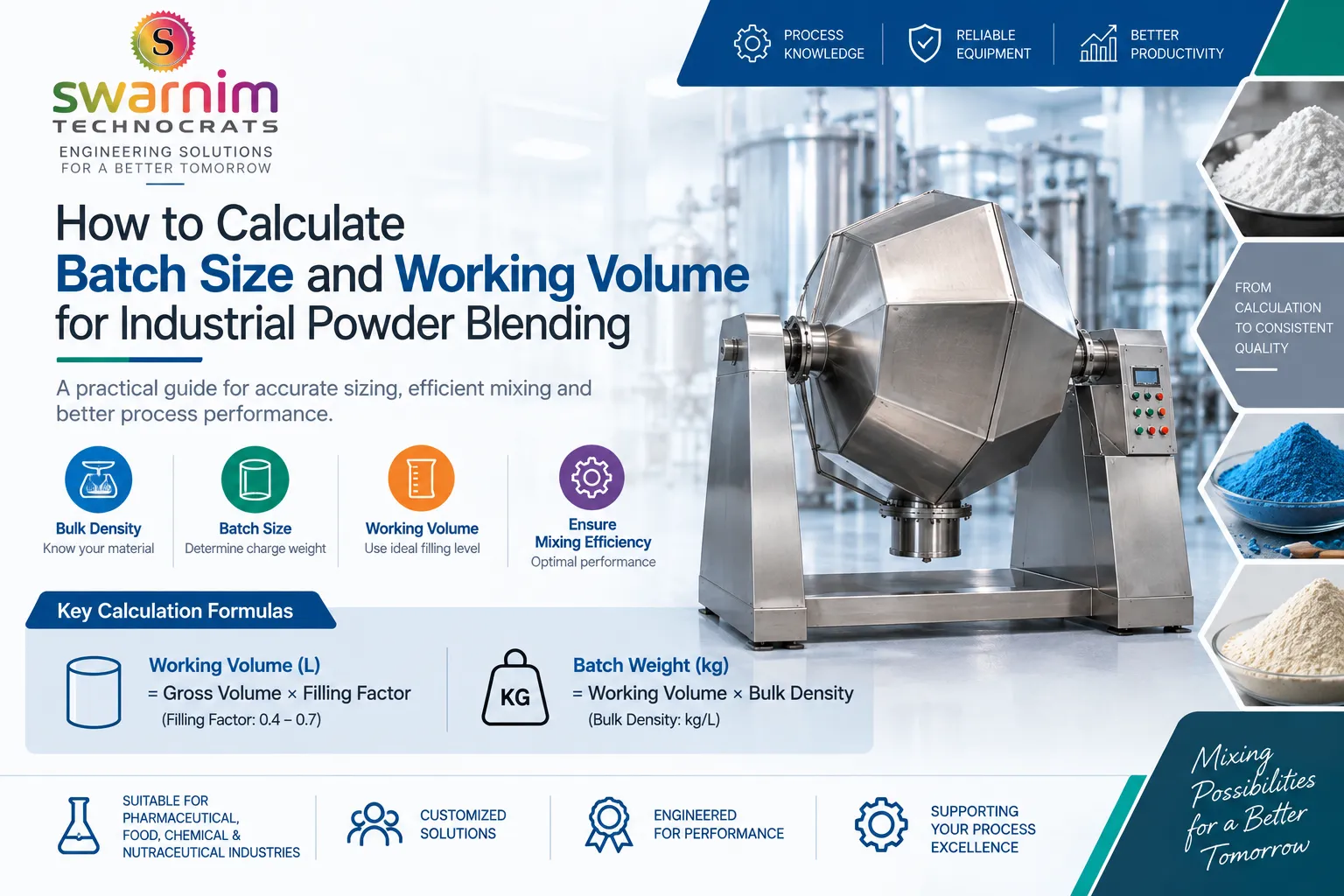
Every blender needs headspace to actually blend. If you fill a drum to its full gross volume, there’s no room left for material to tumble, lift, or fold — it just sits there and rotates as a solid mass. For octagonal blenders, the standard reference point is 70% of gross volume as working volume. A 2,000 L blender, for example, provides approximately 1,400 L of usable working volume at proper fill.
This 70% figure is a starting point for preliminary sizing, not a fixed rule. The actual working volume for your specific batch depends on several material-specific factors that need to be reviewed before finalizing equipment selection.
Factors That Determine Your Actual Working Volume
- Bulk density — how much a given volume of your material weighs when loosely packed. Lighter, fluffier materials often need slightly more headspace than dense powders.
- Tapped density — the density after settling or light compaction, which affects how much the material compresses during blending.
- Particle size — finer powders behave differently under tumbling than coarse granules, affecting how quickly they achieve uniform distribution.
- Flowability — free-flowing powders blend faster and more predictably than sticky or cohesive materials.
- Cohesiveness — cohesive materials may need baffles or a different fill ratio to break up clumping during the tumble cycle.
- Batch weight — your target batch weight, converted through bulk density, tells you the actual volume you need the blender to hold.
- Required blend uniformity — a tighter uniformity specification (common in pharma) may call for a more conservative fill ratio than a less regulated application.
- Product sensitivity — shear-sensitive granules or coated particles may need a gentler fill and speed combination to avoid degradation.
A Simple Working Example
Say your target batch weight is 1,000 kg and your material’s bulk density is 500 kg/m³ (0.5 kg/L). Your required volume is 1,000 kg ÷ 0.5 kg/L = 2,000 L of actual material volume.
Applying the 70% working volume rule in reverse: 2,000 L ÷ 0.70 = approximately 2,857 L gross blender volume needed. In this case, a 3,000 L blender would be the appropriate standard capacity, giving you working volume slightly above your requirement with some margin for batch weight variation.
Why Motor Sizing Follows the Same Logic
Just as gross volume doesn’t tell you working volume, working volume alone doesn’t tell you the correct motor power. Motor selection depends on batch mass, bulk density, torque requirement, rotational speed, starting load, gearbox ratio, and operating cycle — not volume in isolation. Two blenders of the same gross volume running different materials at different densities can require different drive specifications entirely.
Does the Blender Type Change the Calculation?
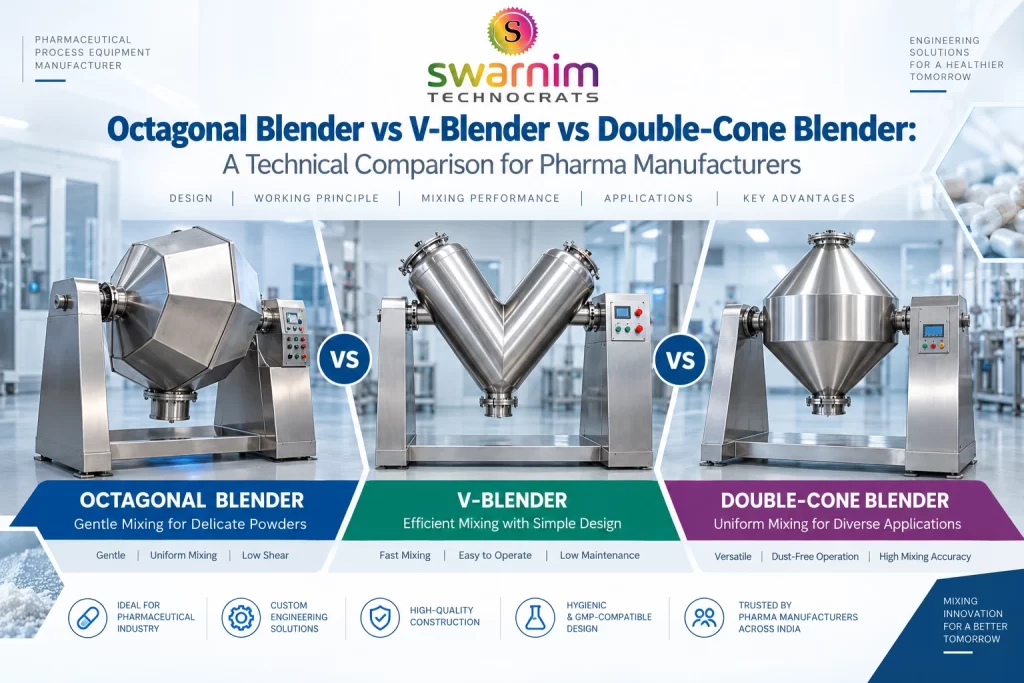
The 70% working volume principle applies broadly across tumble blender designs, but how forgiving a design is outside that ratio varies. If you’re still deciding between blender types before running these numbers, our comparison of octagonal blenders vs V-blenders vs double-cone blenders explains why fill-level tolerance differs by drum geometry — which matters if your batch weight varies from run to run.
Getting an Accurate Sizing Calculation
Standard sizing tables are useful for preliminary evaluation, but the final specification should always be confirmed against your actual material’s bulk density, tapped density, and required blend uniformity before you finalize an order. Swarnim Technocrats’ engineering team reviews these figures directly with clients — send your material density profile and target batch weight, and we’ll return an accurate working volume and drive specification rather than a generic capacity match.
Full standard specifications across our capacity range are available on our octagonal blender manufacturer page, including gross volume, working volume, motor power, and dimensions for models from 100 L to 5,000 L. If your process needs different mixing dynamics altogether, our ribbon blenders page covers sizing for continuous and higher-shear applications.