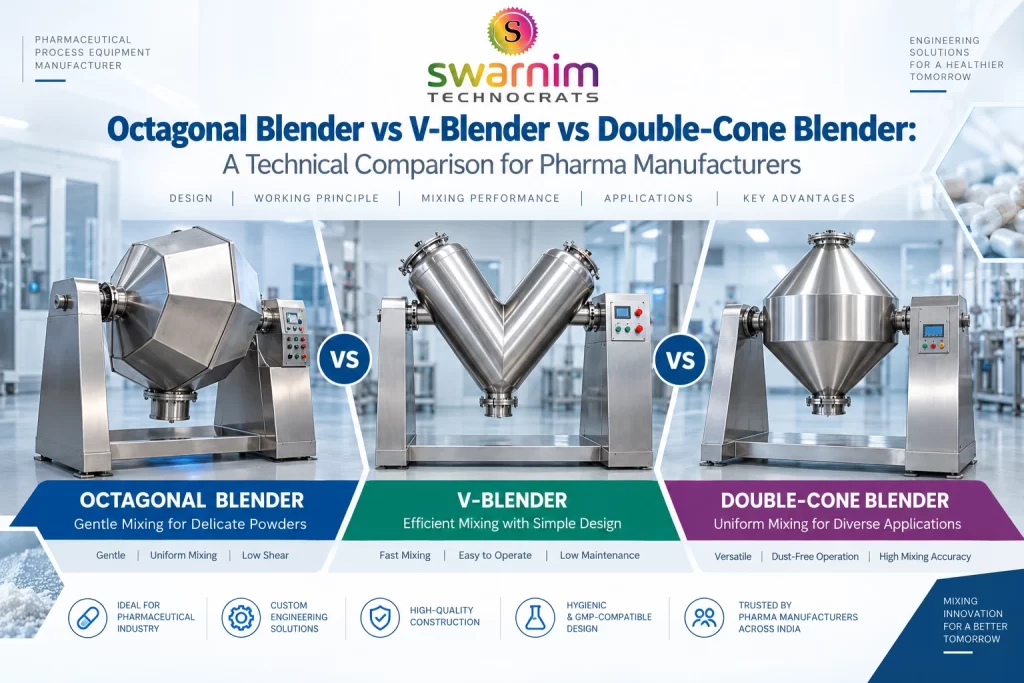
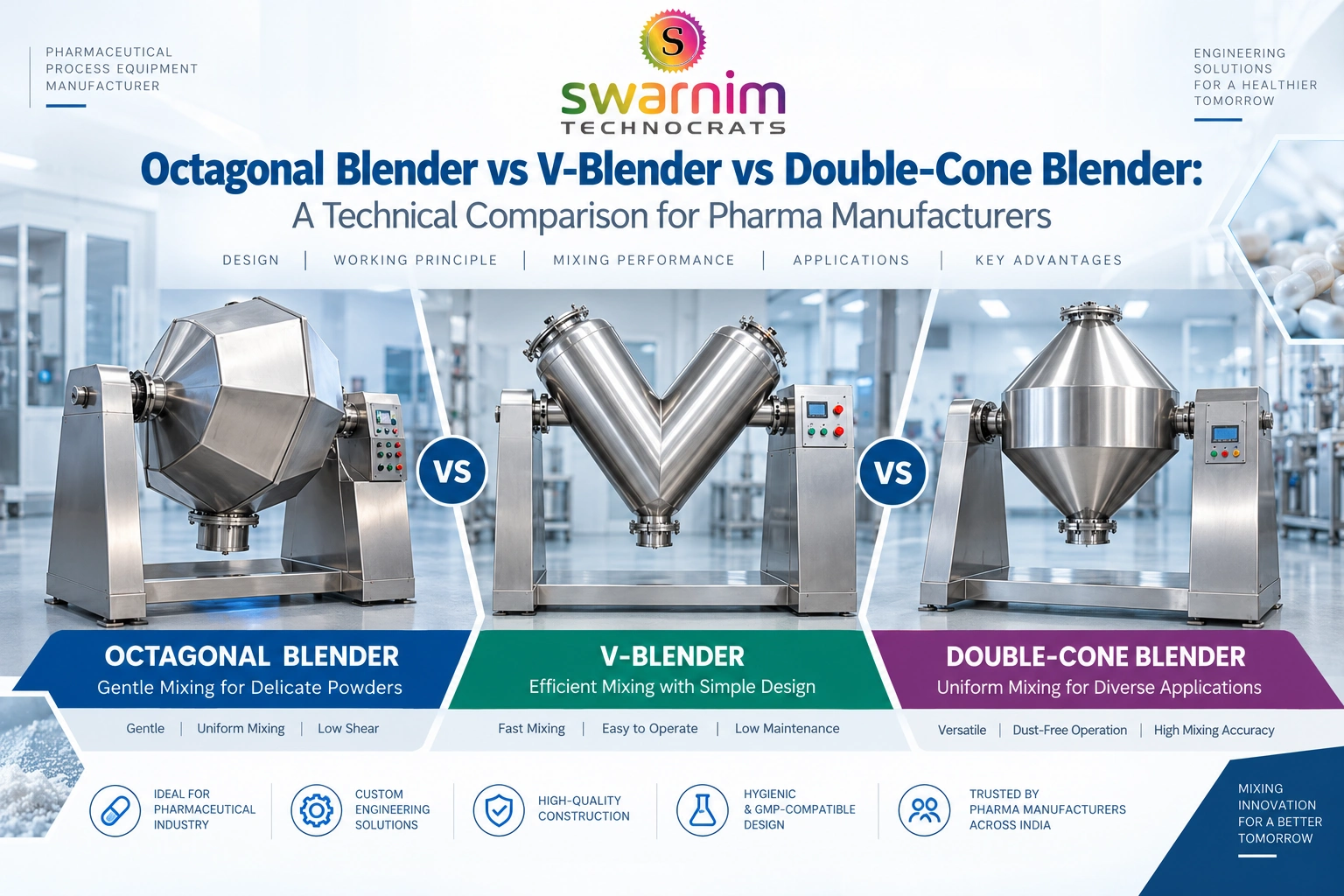
Choosing a blender isn’t just a capacity decision — it’s a geometry decision. Octagonal blenders, V-blenders, and double-cone blenders all work on the same tumble-mixing principle, but the shape of the drum changes how material moves inside it, and that has a direct effect on blend time, uniformity, and how forgiving the equipment is across different batch fill levels.
For a production head or formulation engineer evaluating equipment, understanding this difference upfront avoids a costly mismatch between the blender you buy and the process you actually run.
How Each Design Moves Material
A V-blender uses two cylindrical arms joined at an angle. As it rotates, material splits into the two arms and recombines at the junction. This works well at a specific fill level, but performance drops off sharply outside that range — too little material and it doesn’t mix at the junction properly, too much and there’s no room for the tumbling action to happen at all.
A double-cone blender uses two cone-shaped ends joined at a central cylinder. It shares the same fill-sensitivity issue as the V-blender — the cone tips are prone to forming dead zones where material barely moves, especially at partial fill levels.
An octagonal blender uses a single eight-sided drum. Because every face is flat rather than curved or tapered, material lifts and folds across all eight planes on every rotation, regardless of exactly how full the drum is. This is why an octagonal blender manufacturer typically builds equipment that tolerates a wider range of batch fill levels without a major drop in blend uniformity — the geometry doesn’t rely on a precise fill point the way a V or double-cone design does.
Blend Time and Uniformity
For most dry powder and granule applications, octagonal blenders reach acceptable blend uniformity faster than V-blenders or double-cone blenders of comparable capacity, because material turnover happens continuously across the drum rather than concentrating at a junction point or cone tip. Shorter blend times mean higher batch throughput on the same equipment, which matters when you’re running multiple SKUs through one blender in a shift.
Cleaning and Validation
Octagonal blenders with mirror-polished internal surfaces and sloped, self-draining geometry tend to be more straightforward to validate for cGMP cleaning protocols. There are no internal corners created by the arm-junction of a V-blender or the cone-cylinder joint of a double-cone design — fewer geometric transitions mean fewer places for residue to collect, which simplifies swab testing during validation.
Which One Fits Your Process
- Choose a V-blender if your batch sizes are highly consistent and you’re not blending shear-sensitive material — it’s a proven, simple design when fill level doesn’t vary much.
- Choose a double-cone blender for similar consistent-fill scenarios, particularly where a slightly gentler mixing action is preferred.
- Choose an octagonal blender if your batch sizes vary, your material is shear-sensitive (granules, coated particles, APIs), or you need faster cleaning turnaround between product changeovers — this is the design most pharma and nutraceutical manufacturers move toward once they scale past pilot batches.
Getting the Sizing Right, Whichever Design You Choose
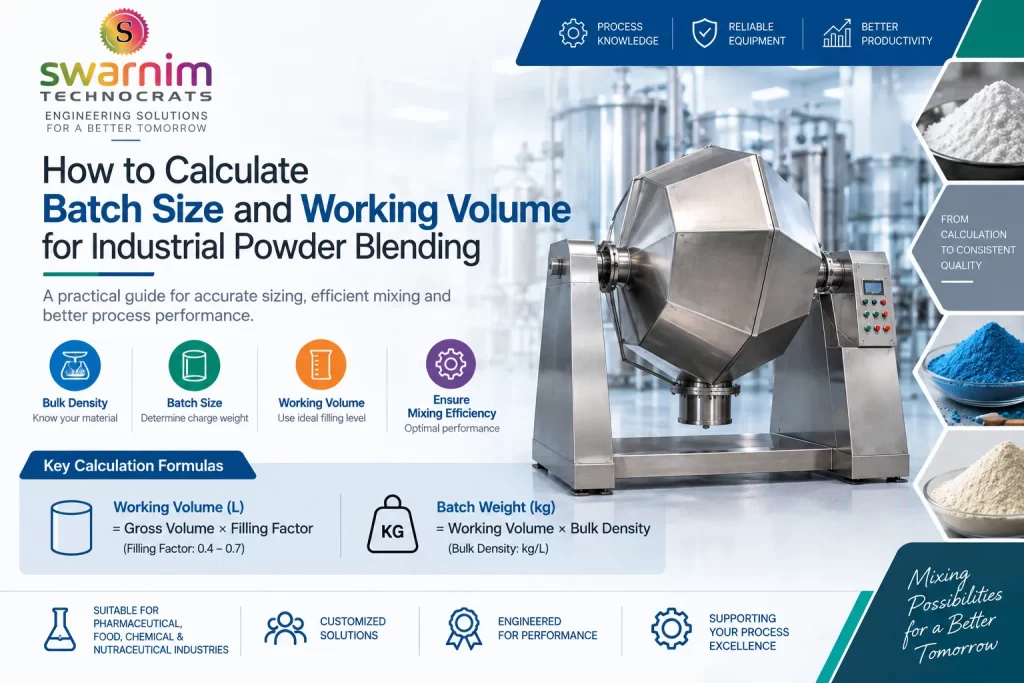
Regardless of geometry, working volume is never the same as gross drum volume — headspace is what makes the tumbling action possible in the first place. If you haven’t worked out your target batch size against bulk density yet, our guide on how to calculate batch size and working volume for industrial powder blending walks through the calculation with a worked example.
Swarnim Technocrats manufactures octagonal blenders from 10 L to 20,000 L, built to cGMP requirements under Schedule M, with SS 316 contact parts and mirror-polished internals as standard. If your process needs continuous or higher-shear mixing instead of tumble blending, it’s also worth comparing against our ribbon blenders, or if you’re sourcing upstream processing equipment for the same line, our SS reactors are built to the same fabrication standard.
For your specific batch size, material characteristics, and factory layout, send us your requirement and our engineering team at Ankleshwar GIDC will return an accurate specification and quote.